Solar
Solar: Sun, Aurora & Eclipse
Space weather you can actually read. A live view of the Sun with every numbered sunspot region, and a clear warning when a flare or CME is on its way to Earth.
- Live SunNASA SDO imagery with numbered active regions, rotated to the current time.
- EarthAn animated magnetosphere showing what the solar wind and CMEs are doing to it right now.
- Aurora tonightA go, maybe or stay-in score from aurora chance, cloud cover, darkness and the Moon.
- EclipsesHow each coming eclipse will look from where you are.
- HistoryA calendar back to 1818 for sunspots and 1932 for geomagnetic storms.
- Alerts & widgetsNotifications for flares, storms and CMEs, plus six home-screen widgets.
Data: NOAA SWPC, NASA SDO & DONKI, SILSO, GFZ Potsdam, Open-Meteo
Tap around. It's the real app · sample data
See it in action
A 20-second tour of Solar
Recorded from the real app, stepping through every tab: Sun, Events, Activity, Earth, Aurora and Eclipse.
Inside the app
Solar, screen by screen
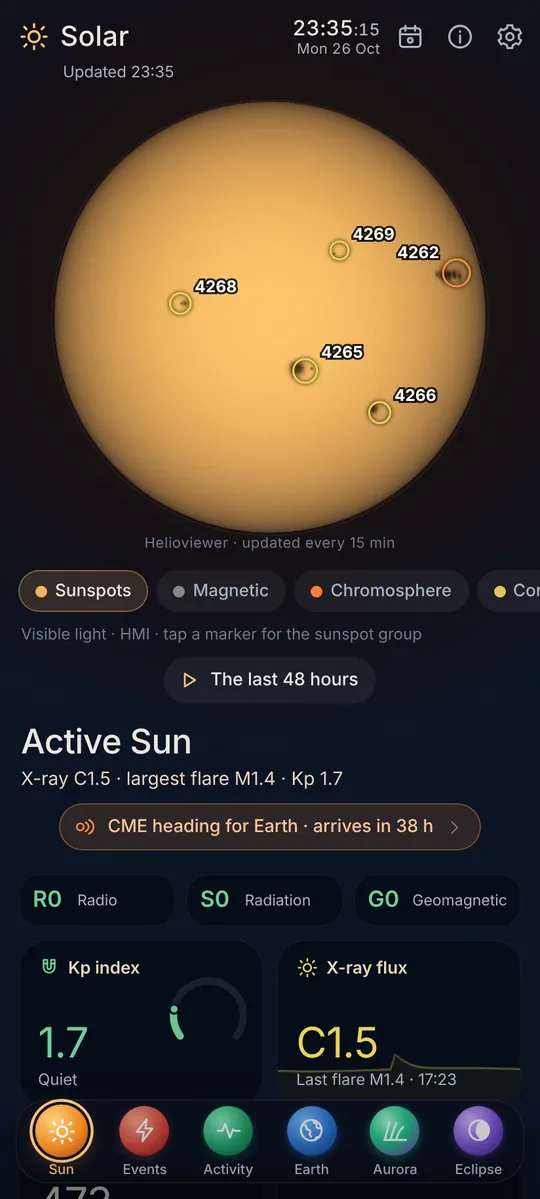
The live Sun with numbered sunspot regions 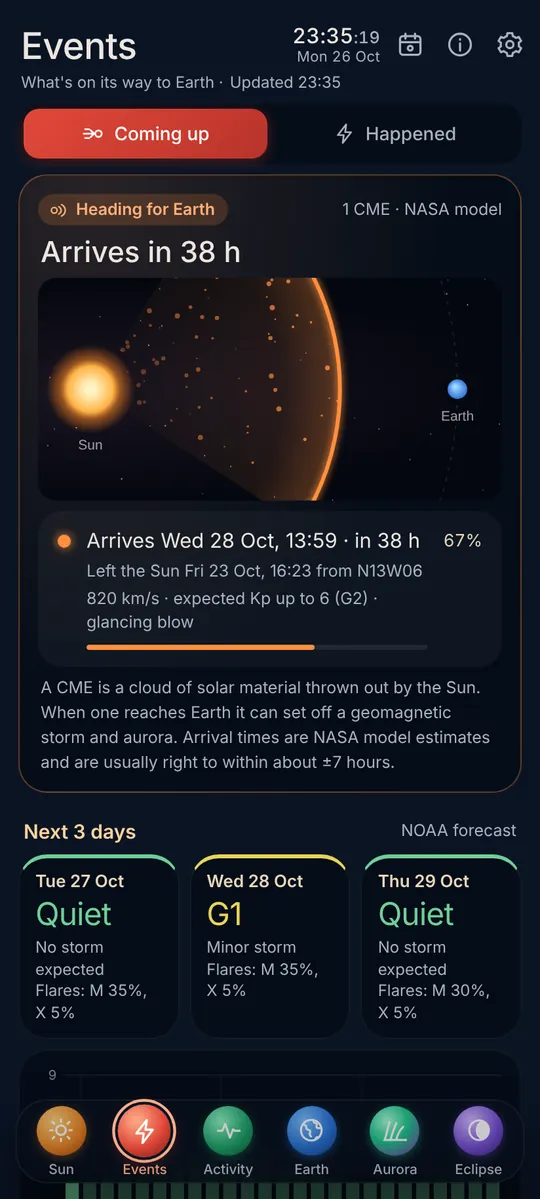
CMEs on their way, with arrival times 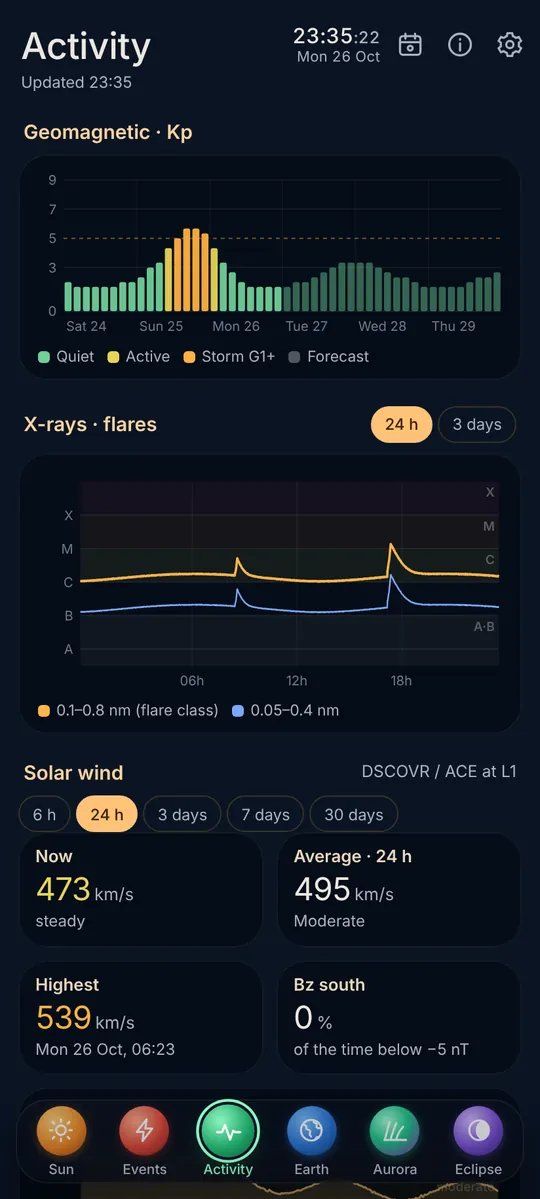
Kp, X-ray and solar wind charts 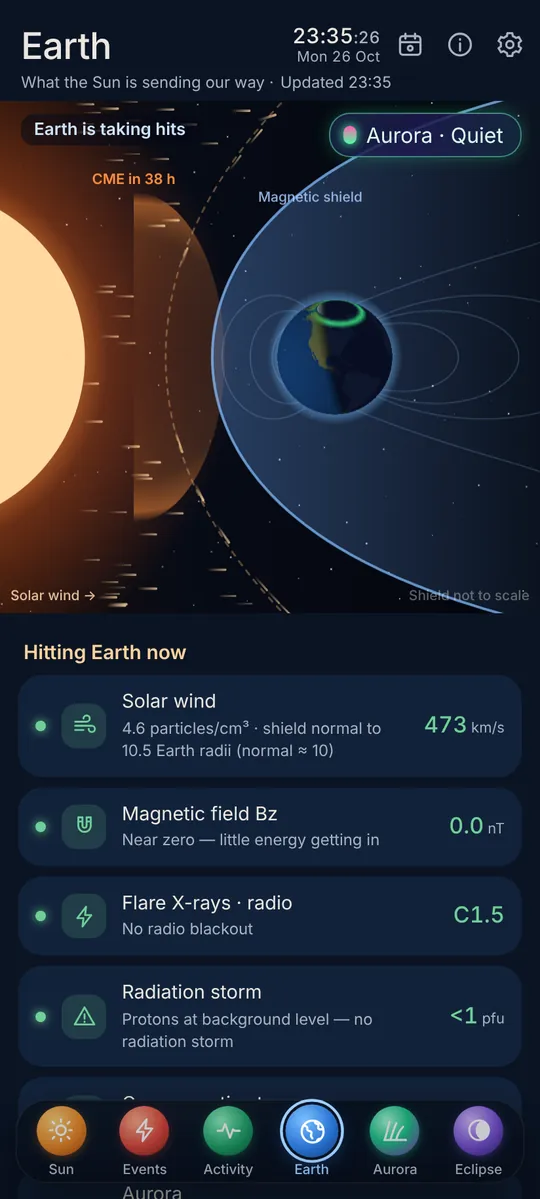
What is hitting Earth right now 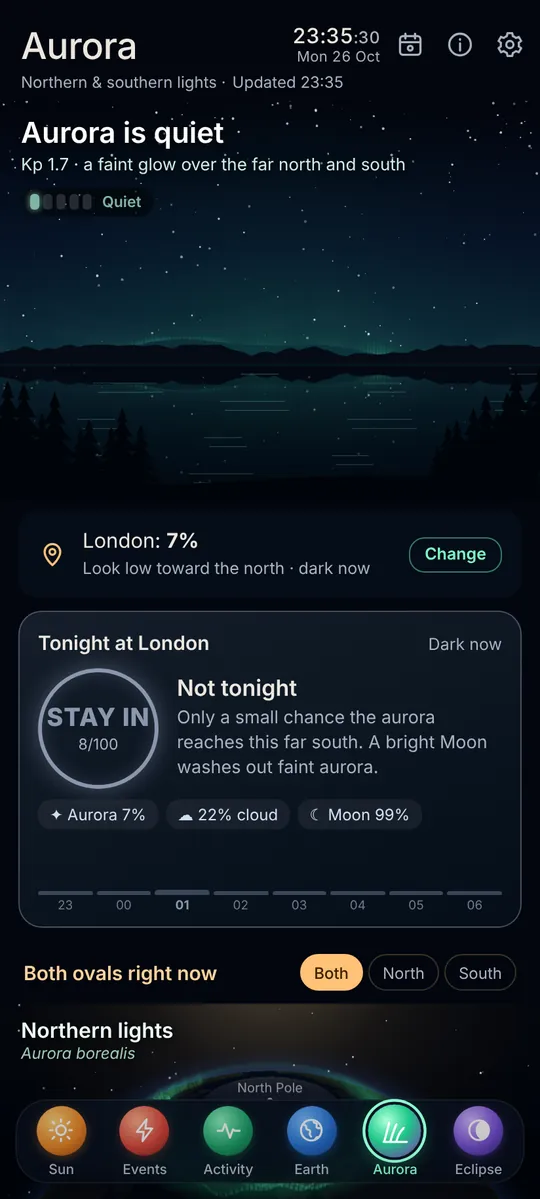
Tonight's aurora verdict for your place 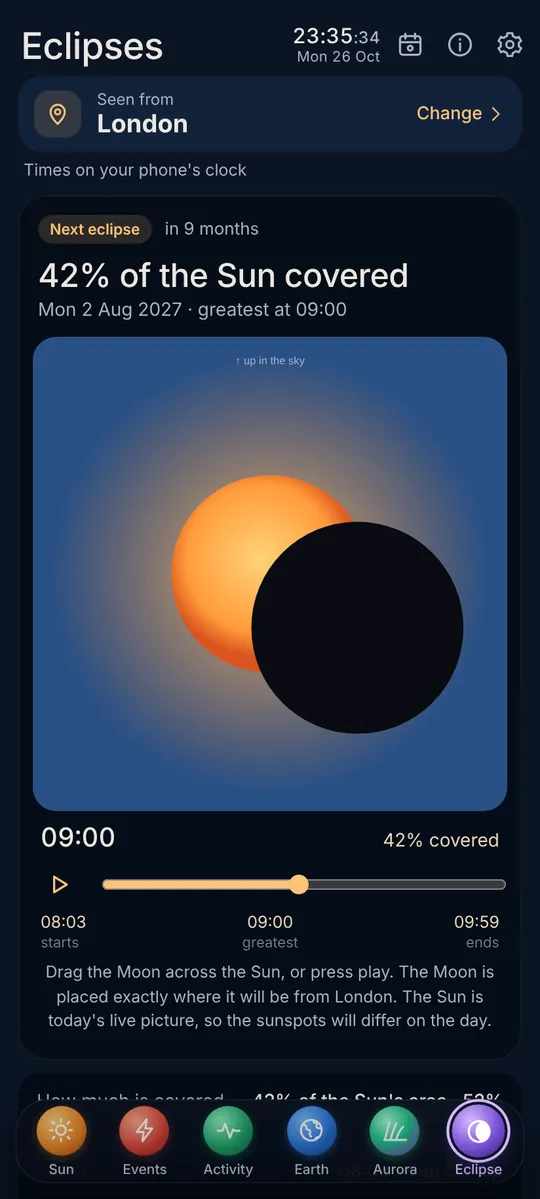
The next eclipse as seen from you
Screens shown with sample data.
About the app
What Solar does
Solar is a space weather app for anyone who wants to know what the Sun is doing and whether it matters for them tonight. It turns the same data that forecasters at NOAA's Space Weather Prediction Center use into a few clear screens: the Sun as it looks right now, what is heading towards Earth, and what that means for the aurora where you are.
Open the app and the first thing you see is a live picture of the Sun from NASA's Solar Dynamics Observatory, with every numbered sunspot region marked on it. Tap a region to see its size, its magnetic class and how likely it is to produce a flare. Switch to other wavelengths to see the corona, flares and coronal holes.
Solar flare and CME alerts
When a flare goes off, Solar shows its class (C, M or X) and the radio blackout level on NOAA's R scale. When NASA's models show a coronal mass ejection (CME) heading for Earth, the app shows when it is expected to arrive and how strong the geomagnetic storm could be.
Alerts clear themselves once the event is over. With Solar Pro you set your own levels for storms, flares and radiation storms, and quiet hours for the night.
Aurora forecast and the Kp index
The Kp index measures how disturbed Earth's magnetic field is, on a scale from 0 to 9. The higher it goes, the further from the poles the northern lights can be seen. Solar shows the current Kp, NOAA's three-day forecast and the solar wind readings measured by spacecraft 1.5 million km upstream of Earth.
With Solar Pro, the Aurora tab combines NOAA's OVATION aurora model with the cloud forecast, how dark it will get and the Moon, then gives you a simple answer for your location: go, maybe, or stay in. It also shows both poles on spinning globes.
Eclipses from where you are
The Eclipse tab, part of Solar Pro, plays out every eclipse as it will look from your place, with the exact local times, world path maps and every eclipse past and future.
Sunspot and storm history
The free version shows the last seven days. With Solar Pro, a calendar goes back to any day since 1818 for the sunspot number, to 1932 for geomagnetic storms, and shows the Sun's picture for every day since 1996.
Free, with an optional Pro upgrade
Solar is free to download with no ads. The Pro upgrade unlocks extra features for people who use it every day. Try Pro free for 7 days.
Free
- Live Sun with numbered sunspot regions
- Kp index, solar wind and NOAA scales
- Flare, CME and storm events and alerts
- The last 7 days of history
- Sun, Kp, strip and classic widgets
Pro
- Full Earth, Aurora and Eclipse tabs
- All 8 views of the Sun and a 48-hour time-lapse
- Pro charts: X-ray flux and the 3-day Kp forecast
- Your own alert levels and quiet hours
- The full history back to 1818
- Aurora tonight and full-page widgets
Where the data comes from
- NOAA SWPC: Kp index, solar wind, X-ray flux, R/S/G scales, alerts, OVATION aurora model
- NASA SDO & Helioviewer: Images of the Sun
- NASA DONKI: Flare, CME and geomagnetic storm records
- SILSO: Sunspot numbers since 1818
- GFZ Potsdam: Kp since 1932 and F10.7 radio flux
- Open-Meteo: Cloud forecast and place search
The app fetches this data directly from each source. It doesn't go through our servers, and there is no account or tracking. Privacy policy.
Read the guide: The Kp Index Explained: How Far South Can You See the Aurora?
Read the guide: Solar & Lunar Eclipses 2027–2030: Dates & Where to See Them
Good to know
Solar questions
What is the Kp index?
The Kp index is a 0 to 9 scale of how disturbed Earth's magnetic field is, measured every three hours. Kp 5 and above counts as a geomagnetic storm (G1 to G5 on NOAA's scale), and that is when the aurora starts to be seen further from the poles.
Can Solar tell me if I will see the northern lights tonight?
Yes, with Solar Pro. The Aurora tab combines NOAA's OVATION aurora forecast, the cloud forecast for your location, how dark it will be and the Moon into one score with a clear go, maybe or stay-in answer.
How much warning is there before a CME reaches Earth?
A coronal mass ejection usually takes one to four days to reach Earth. Solar shows the arrival time estimated by NASA's models as soon as one is published, and can notify you when a CME is expected.
Where do the pictures of the Sun come from?
From NASA's Solar Dynamics Observatory (SDO), which photographs the whole Sun every few minutes. The app also uses Helioviewer when the SDO images are delayed.
Does Solar have home-screen widgets?
Yes, six: the Sun, the Kp index, a compact strip and a classic layout are free, and the aurora tonight and full-page widgets come with Solar Pro.
What does Solar Pro add?
The full Earth, Aurora and Eclipse tabs, all eight views of the Sun with a 48-hour time-lapse, extra charts, your own alert levels, the full history back to 1818 and two extra widgets. You can try it free for 7 days.
From the same maker
More apps for the sky
Questions or ideas?
Found a bug, want a feature, or spotted something odd in the sky data? Get in touch.
hello@nearspace.app