Overhead
ISS & satellite passes
Never miss the ISS again. Overhead works out every pass from your location, tells you how good it will look, and points your camera to where it will appear.
- Pass predictionsRise, peak and set times with height and brightness for the ISS and other satellites.
- Viewing scoreEach pass rated 0–100 from height, brightness, darkness, Moon and cloud.
- LookHold up your phone and the camera view marks where to watch.
- RadarA 3D Earth with satellites circling it in their real orbits.
- Planets & night visionMercury to Saturn on the sky chart, and a red mode that keeps your eyes dark-adapted.
- Widgets & alertsNext-pass countdown, upcoming passes and a live map on your home screen.
Data: CelesTrak orbital elements, Open-Meteo cloud cover, Wikipedia & Wikidata satellite details
Tap around. It's the real app · sample data
See it in action
A 20-second tour of Overhead
Recorded from the real app, stepping through every tab: Now, Passes, Sky, Radar and Satellites.
Inside the app
Overhead, screen by screen
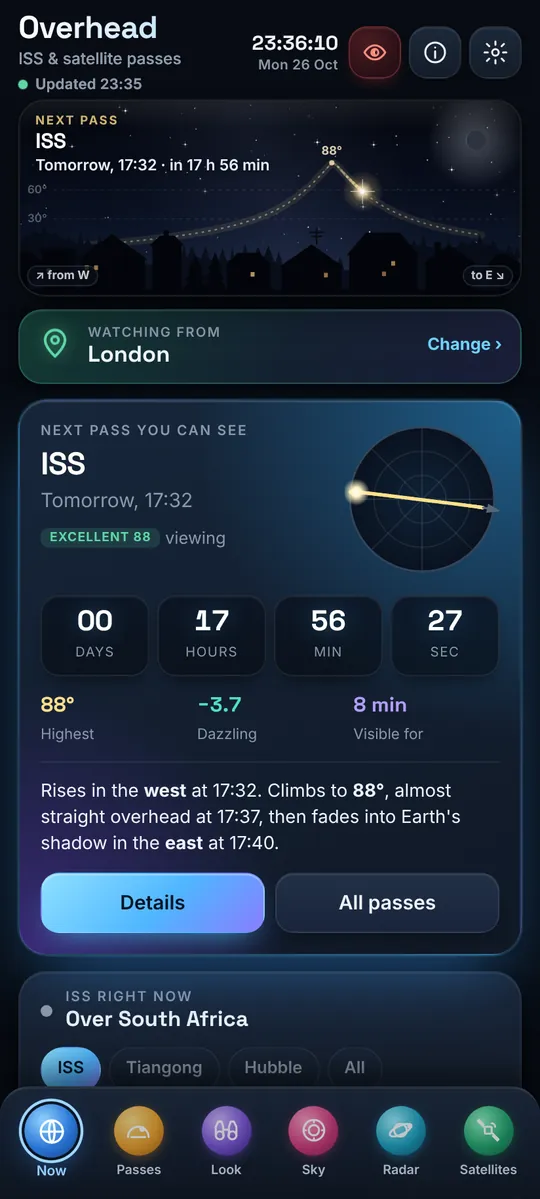
The next pass and its viewing score 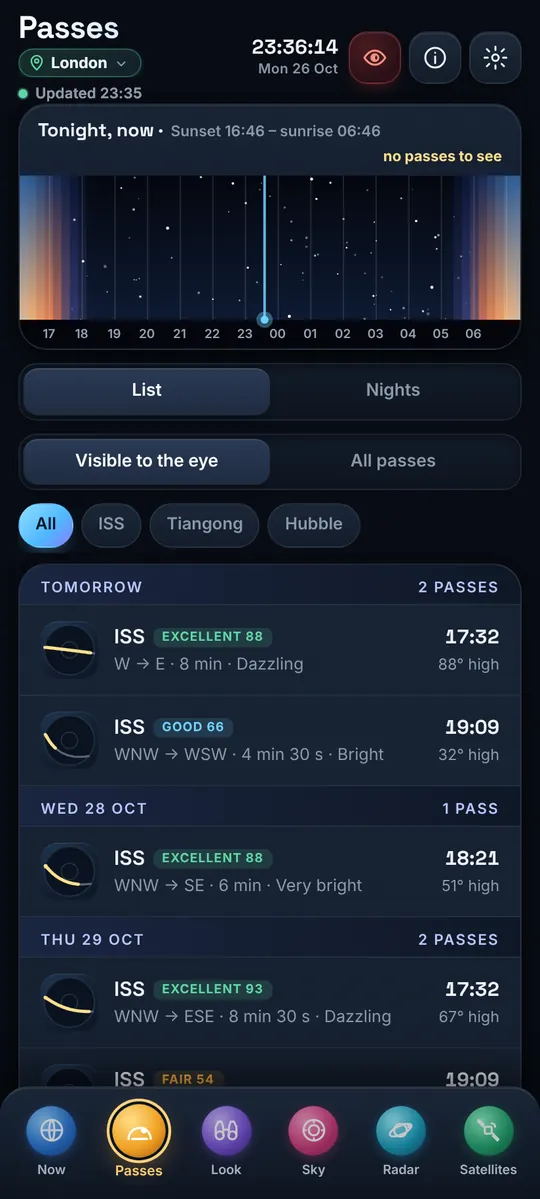
Every visible pass this week 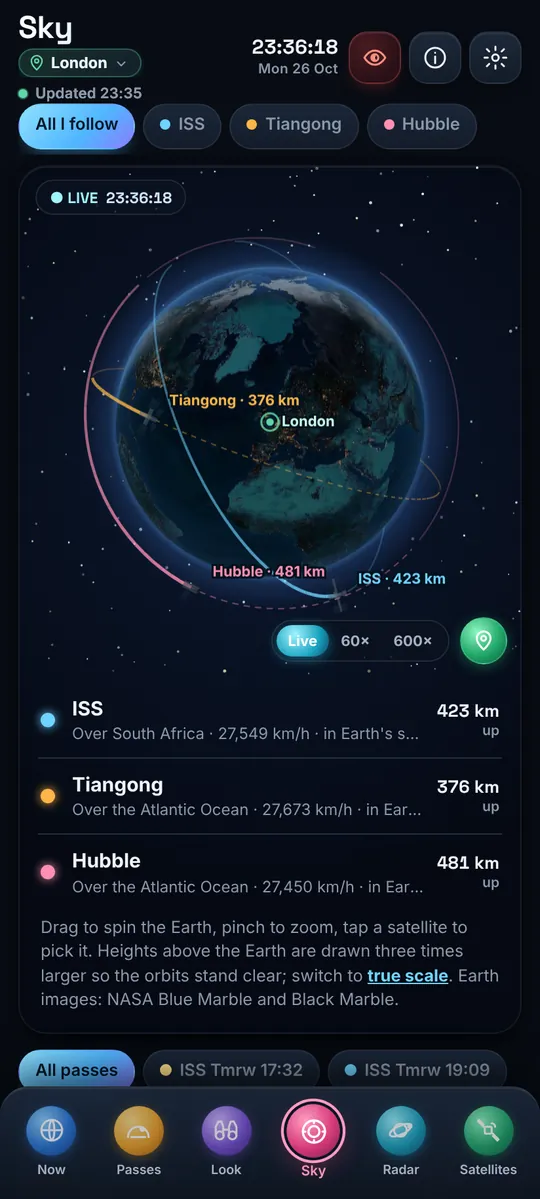
A 3D globe with the satellites you follow 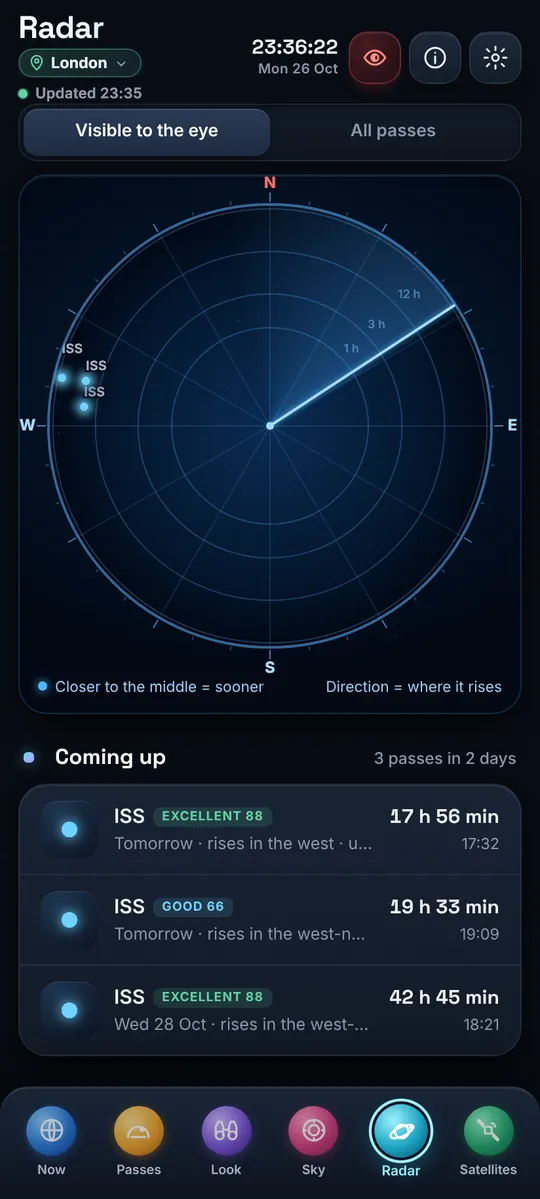
Where each pass rises and sets 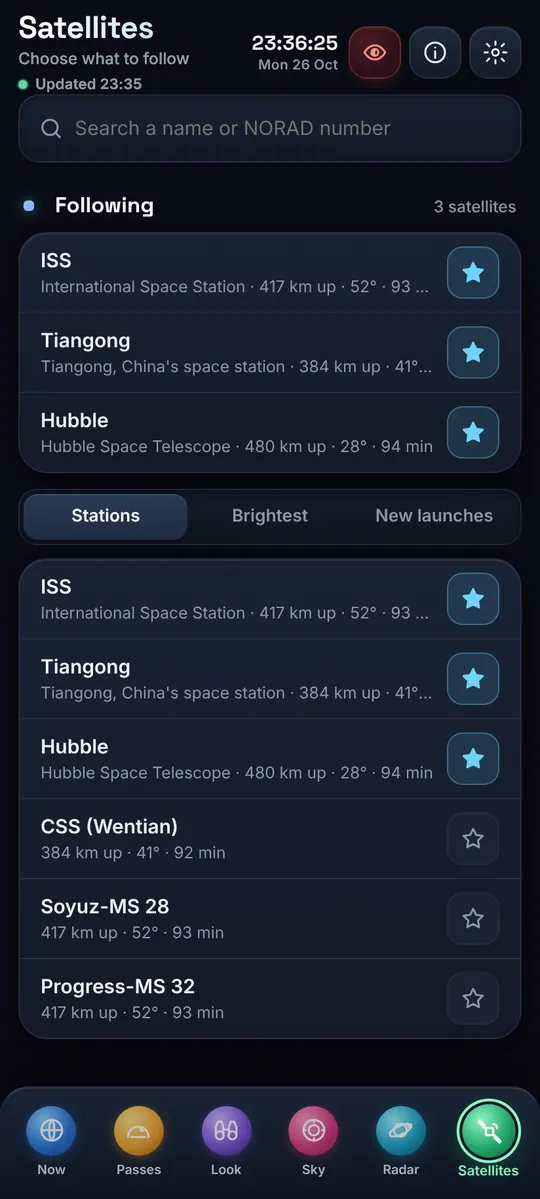
Follow the ISS, Tiangong, Hubble and more
Screens shown with sample data.
About the app
What Overhead does
Overhead is an ISS tracker and satellite pass predictor. It works out when the International Space Station, China's Tiangong station, the Hubble Space Telescope and other bright satellites will cross your sky, and whether you will actually be able to see them.
Every pass is calculated on your phone from the latest orbital elements, using the same SGP4 model that satellite trackers around the world use. You get the time it rises, the highest point and where it fades, with a countdown to the next one.
Which passes are worth going outside for
Not every pass is a good one. Overhead rates each one from 0 to 100 using how high it climbs, how bright it will be, how dark your sky is, the Moon and the cloud forecast, so you can see at a glance which ones are worth the trip outside.
Satellites shine by reflecting sunlight, so you see them best for an hour or two after sunset and before sunrise, when you are in darkness and they are still in sunlight. Overhead shows where each pass appears out of Earth's shadow or fades into it.
Find it in the sky
The Look tab, part of Overhead Pro, uses your camera and compass: hold up your phone and it marks where the satellite will appear and the path it will take. The Sky tab draws the whole sky with the planets from Mercury to Saturn, and a red night-vision mode keeps your eyes adjusted to the dark.
Where is the ISS right now?
The Now tab shows where the ISS is over the Earth this second, and Radar shows a 3D globe with the satellites you follow circling it in their real orbits.
On your home screen
Alerts remind you a few minutes before a good ISS pass starts. With Overhead Pro, home-screen widgets show a countdown to the next pass, a list of upcoming passes and a live map, and you can get alerts for other satellites too.
Free, with an optional Pro upgrade
Overhead is free to download with no ads. The Pro upgrade unlocks extra features for people who use it every day.
Free
- ISS, Tiangong and Hubble passes
- Viewing score and cloud forecast
- Live position and 3D radar
- Planets and night vision
Pro
- Look: the camera view
- Home-screen widgets
- Alerts for several satellites
- Follow up to five satellites
Where the data comes from
- CelesTrak: Orbital elements for the ISS and tracked satellites
- Open-Meteo: Cloud forecast and place search
- Wikipedia & Wikidata: Satellite photos, size and mass
The app fetches this data directly from each source. It doesn't go through our servers, and there is no account or tracking. Privacy policy.
Read the guide: How to See the International Space Station (ISS) Tonight
Good to know
Overhead questions
When can I see the International Space Station?
The ISS is easiest to see in the hour or two after sunset or before sunrise, when your sky is dark but the station, about 420 km up, is still lit by the Sun. Overhead lists every pass like this for your location and rates how good it will be.
How accurate are the pass times?
Passes are calculated with the standard SGP4 model from orbital elements published by CelesTrak, which the app refreshes regularly. With fresh elements, times are typically accurate to within seconds.
Which satellites can Overhead track?
The ISS, China's Tiangong space station, the Hubble Space Telescope and other bright satellites that are easy to see with the naked eye.
What does the viewing score mean?
It is a 0 to 100 rating of how good a pass will look, based on how high it climbs, how bright it will be, how dark the sky is, the Moon and forecast cloud.
Does Overhead need my camera?
Only for the Look tab (part of Overhead Pro), which shows where to point your phone. Everything else works without it, and nothing from the camera leaves your phone.
From the same maker
More apps for the sky
Questions or ideas?
Found a bug, want a feature, or spotted something odd in the sky data? Get in touch.
hello@nearspace.app