Sky
Night sky & the search for alien signals
Your night sky, with the search for life running through it. See what's up tonight, then find the stars that radio telescopes have listened to for a signal.
- TonightA live horizon scene with the real Moon, planets and meteors, and a 0–100 stargazing score.
- Sky mapA star map that follows your phone, with a slider to wind the sky 12 hours either way.
- ListenOver 5,500 stars and 94 galaxies that Breakthrough Listen pointed the Green Bank Telescope at.
- Our radio bubbleA 3D view of the stars close enough to have already heard our broadcasts.
- SignalsThe Wow! signal, BLC1, fast radio bursts and more, marked solved or still unexplained.
- CalendarMoon phases, meteor showers, eclipses and the days Green Bank was listening.
Data: Breakthrough Listen open data, NOAA SWPC aurora, Open-Meteo cloud cover
Tap around. It's the real app · sample data
See it in action
A 20-second tour of Sky
Recorded from the real app, stepping through every tab: Tonight, Sky, Listen, Signals and Calendar.
Inside the app
Sky, screen by screen
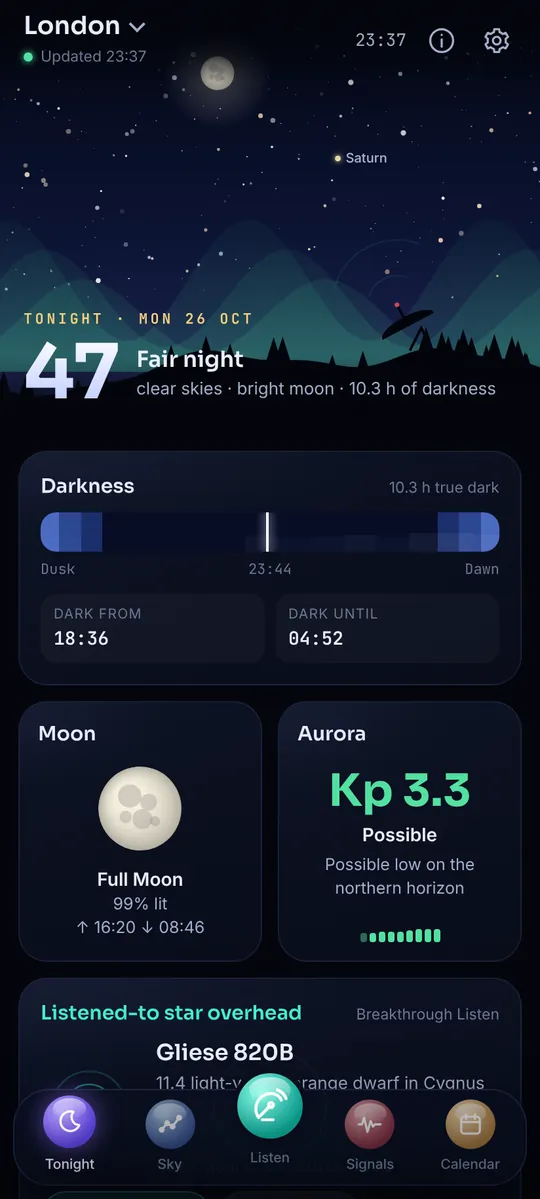
Tonight's stargazing score 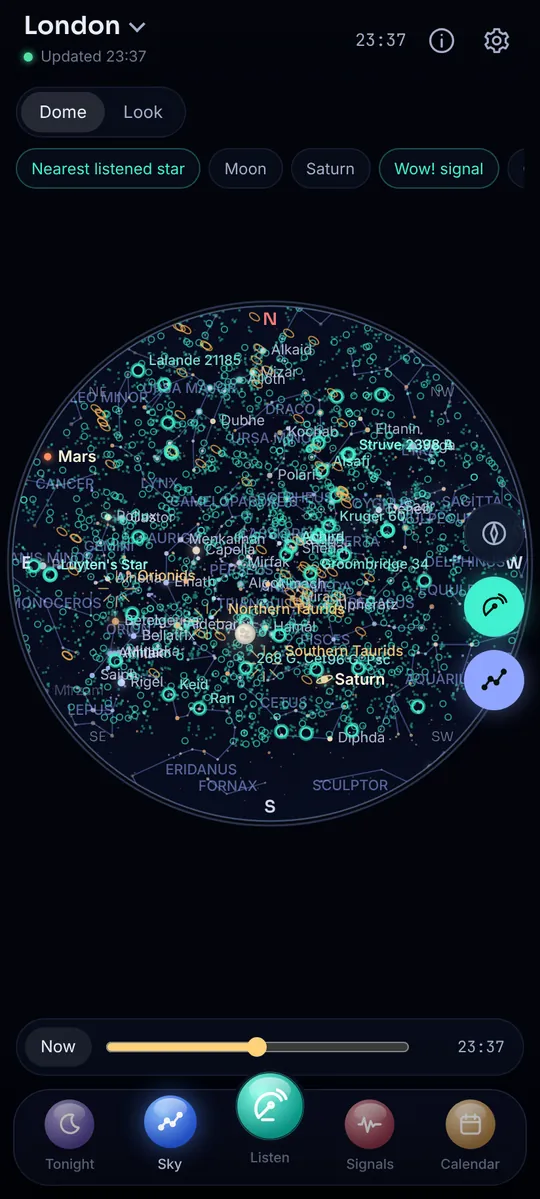
A star map with the listened-to stars 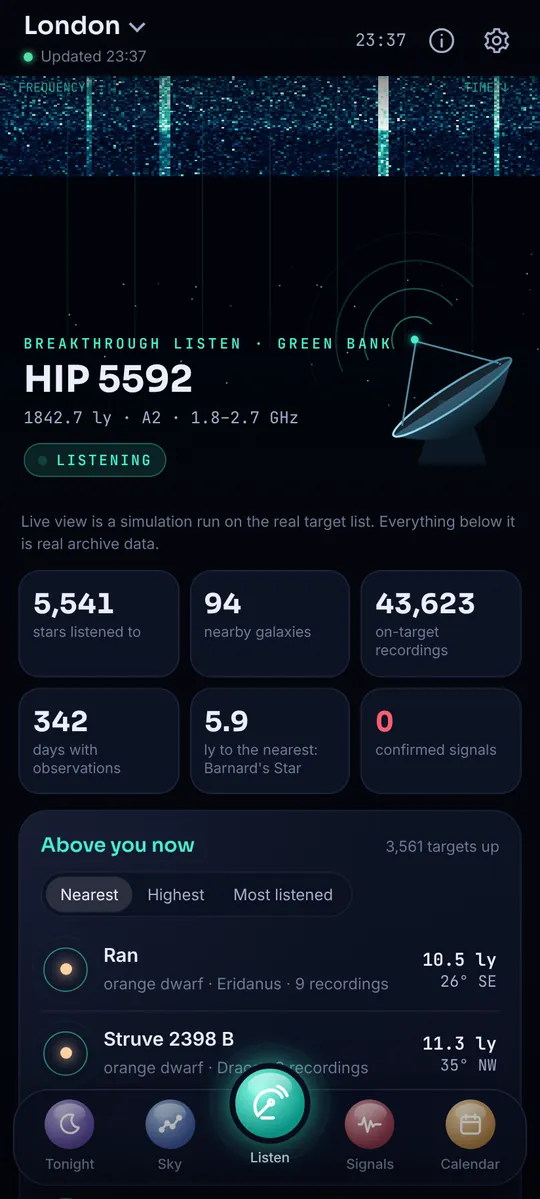
Breakthrough Listen's targets above you 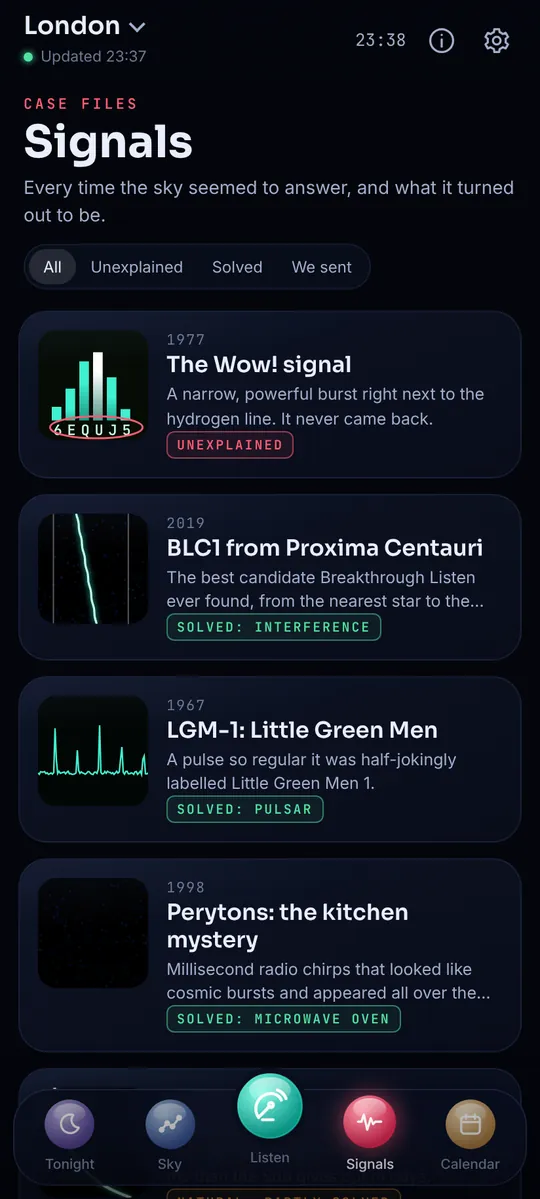
The Wow! signal and other mysteries 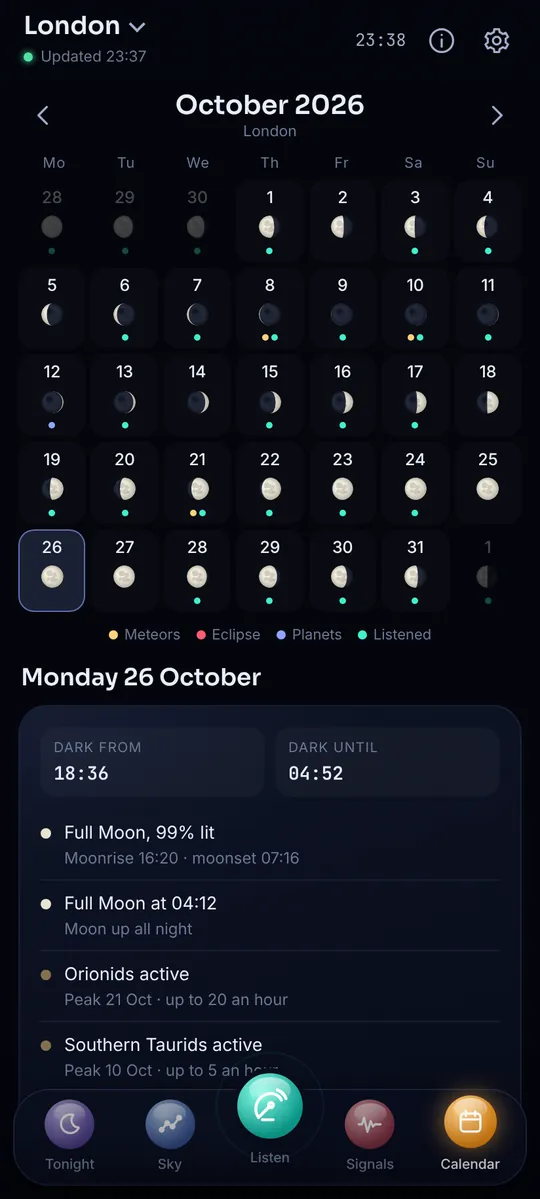
Moon phases and sky events, day by day
Screens shown with sample data.
About the app
What Sky does
Sky is a stargazing app with the search for extraterrestrial intelligence (SETI) built in. It tells you how good tonight is for looking up, shows you what is in the sky, and lets you explore the real stars that the Breakthrough Listen project has searched for radio signals from other civilisations.
The SETI side uses Breakthrough Listen's public index of observations made with the 100-metre Green Bank Telescope between 2016 and 2018: over 5,500 stars and 94 nearby galaxies, each matched to its distance and star type.
Is tonight good for stargazing?
The Tonight tab draws your horizon with the real Moon phase, the planets and the stars, and gives the night a 0 to 100 score from cloud, darkness and moonlight. A timeline shows when true darkness starts and ends, and cards cover the Moon, the aurora chance and the listened-to star highest over you.
A star map that follows your phone
Hold your phone up and the Sky map follows where you point it. Drag the time slider to wind the sky 12 hours forwards or back. Rings mark the stars that Breakthrough Listen has pointed its telescopes at.
Listen: how the search works
Each target was observed in pairs with nearby empty sky. A real signal disappears when the telescope looks away, while interference from Earth does not. The app shows how that works with a waterfall plot, the frequency-against-time picture SETI researchers use, and explains why every candidate so far turned out to be human-made.
Our radio bubble and famous signals
Radio broadcasts strong enough to leak into space began around a century ago, so a bubble about 100 light-years across now carries them. Sky shows the listened-to stars inside it. The Signals tab tells the stories of the Wow! signal, BLC1, pulsars and fast radio bursts, marked solved, likely solved or still unexplained.
Where the data comes from
- Breakthrough Listen: Public index of Green Bank Telescope observations, 2016–2018
- NOAA SWPC: Kp forecast for the aurora chance
- Open-Meteo: Cloud forecast and temperature
The app fetches this data directly from each source. It doesn't go through our servers, and there is no account or tracking. Privacy policy.
Good to know
Sky questions
What is Breakthrough Listen?
Breakthrough Listen is the largest scientific search for signs of intelligent life beyond Earth. It uses large radio telescopes, including the Green Bank Telescope in West Virginia, and makes its data public.
Has anyone found an alien signal?
No. Every candidate signal found by Breakthrough Listen so far has been traced to human-made interference. Sky explains how each one is checked and ruled out.
What was the Wow! signal?
A strong, narrow radio signal picked up by Ohio State University's Big Ear telescope in August 1977. It lasted about 72 seconds and has never been detected again. Its origin is still debated.
What is the stargazing score?
A 0 to 100 rating for tonight at your location, based on the cloud forecast, how dark the sky gets and how much moonlight there is.
Does Sky work without an internet connection?
Mostly. The star catalogue and the Breakthrough Listen data are built into the app. It only goes online for the cloud forecast and the aurora outlook.
From the same maker
More apps for the sky
Questions or ideas?
Found a bug, want a feature, or spotted something odd in the sky data? Get in touch.
hello@nearspace.app