Asteroids & Meteors
Near-Earth flybys and meteor showers
See what's passing Earth this week. Every close approach on a live radar, real impact-risk data from NASA, and a 3D flyby you can ride alongside.
- RadarA live dial of this week's flybys, with the next one counted down.
- 3D flybyFollow an asteroid past Earth on its real path, with the true Sun, Moon and stars.
- RiskNASA's Sentry list of objects with any chance of impact, explained plainly.
- MeteorsShowers with real radiants and rates, plus recent fireballs.
- SkyPoint your phone up to find stars, planets and asteroids.
- HistoryA calendar of close approaches from 1900 to 2200.
Data: NASA/JPL Close Approach, Sentry, Small-Body Database & Fireball APIs
Tap around. It's the real app · sample data
See it in action
A 20-second tour of Asteroids & Meteors
Recorded from the real app, stepping through every tab: Radar, Upcoming, Orbit, Meteors, Risk and History.
Inside the app
Asteroids & Meteors, screen by screen
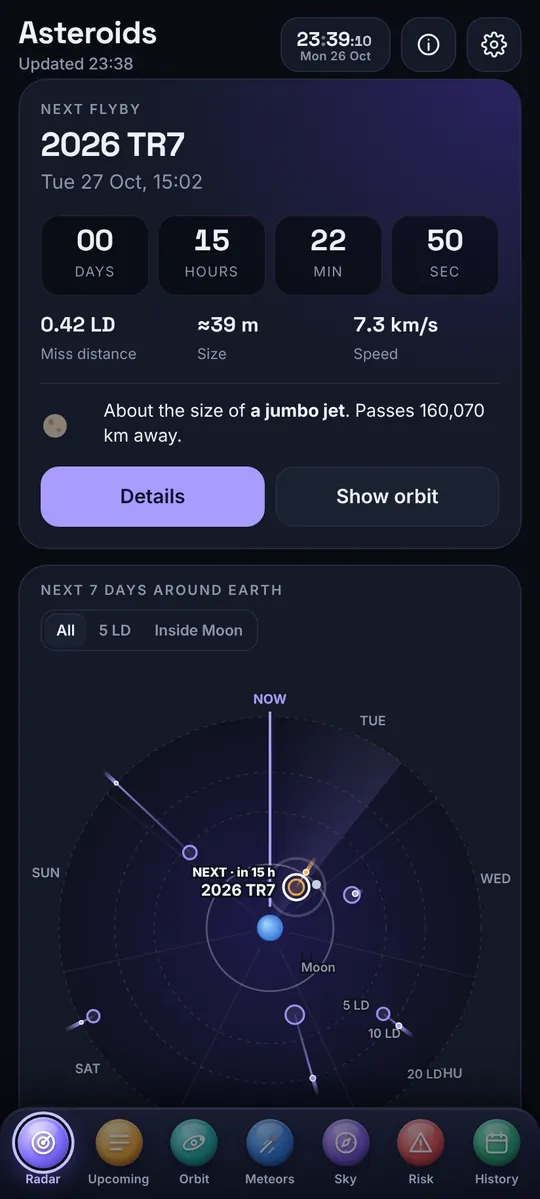
This week's flybys on a live radar 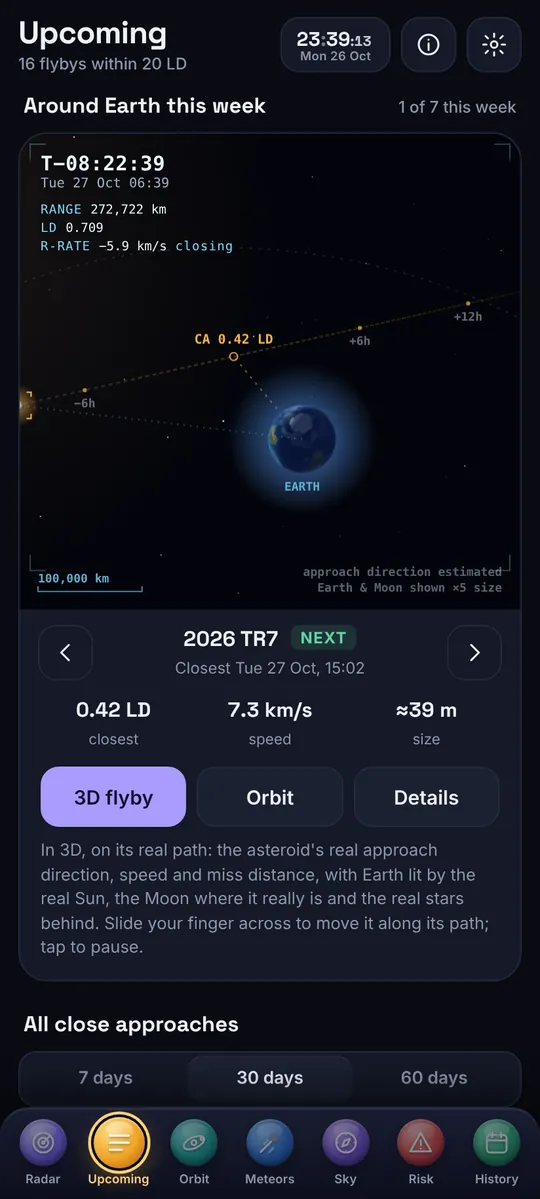
Every close approach, with a 3D view 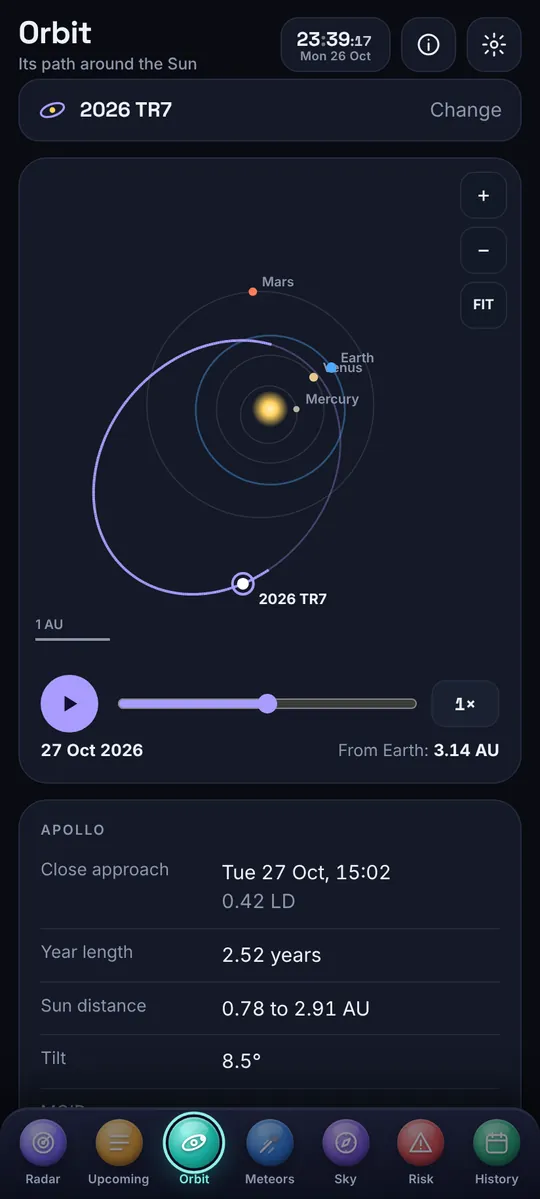
Each asteroid's path around the Sun 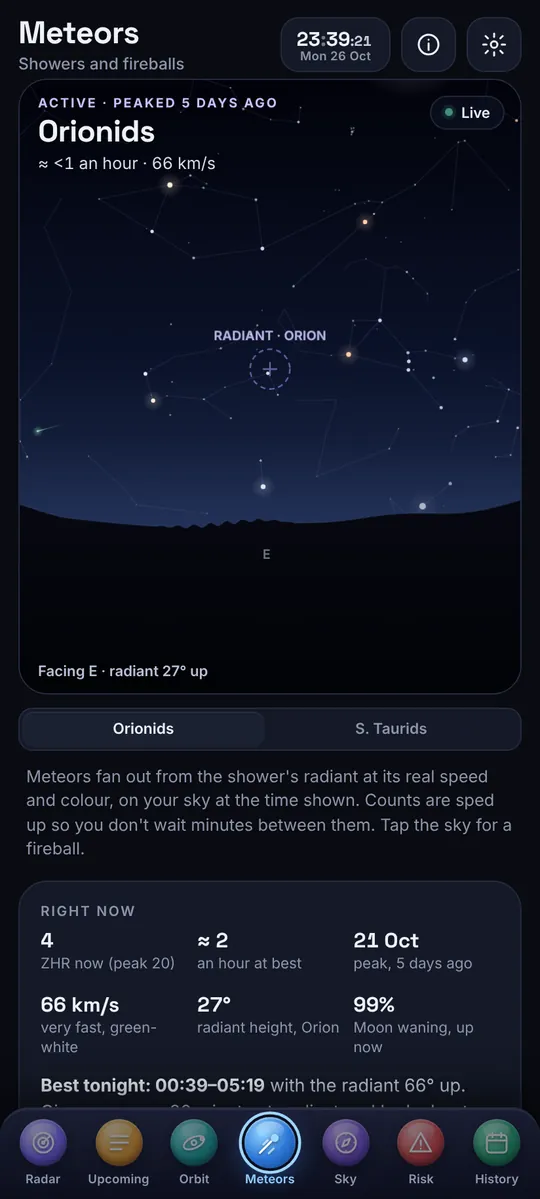
Meteor showers with real radiants 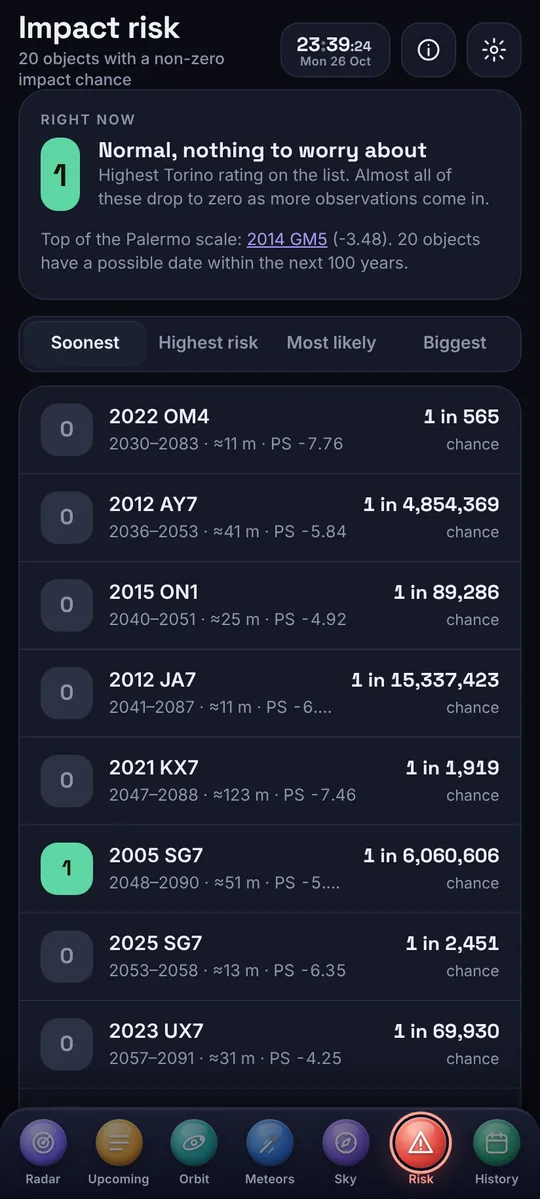
NASA's impact-risk list, explained 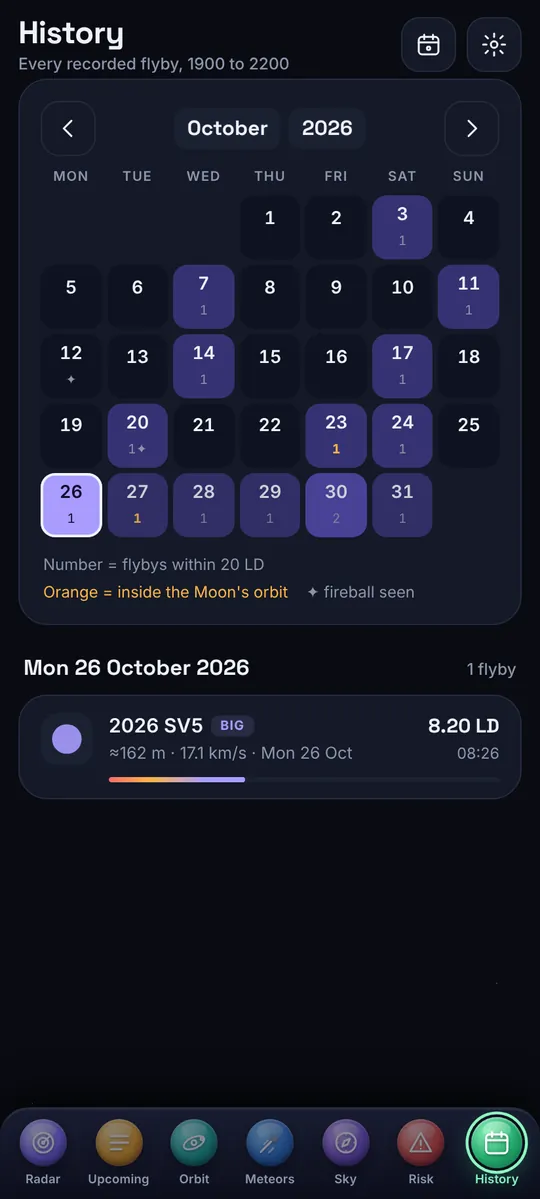
A calendar of flybys from 1900 to 2200
Screens shown with sample data.
About the app
What Asteroids & Meteors does
Asteroids & Meteors is a near-Earth asteroid tracker. Several asteroids pass between the Earth and the Moon every month, and most are only spotted days before they arrive. This app shows every close approach NASA's Jet Propulsion Laboratory has on record, with how close it comes, how fast it is going and roughly how big it is.
Distances are given in lunar distances (LD), the distance from Earth to the Moon, about 384,400 km. Anything inside 1 LD passes closer than the Moon.
A radar of this week's flybys
The Radar tab shows the next seven days as a dial around Earth, with each asteroid placed by when and how close it passes. The next one is highlighted with a countdown. Upcoming lists the next 60 days, which you can filter by size and distance.
Ride along with a 3D flyby
For each close approach you can watch a 3D flyby: the asteroid follows its real path past Earth, with the Earth turned to the right time, lit from where the Sun really is, and the real stars behind it.
Is anything going to hit us?
The Risk tab shows NASA's Sentry list: every known object with any chance of hitting Earth in the next century, with the Torino and Palermo scale ratings explained in plain words. Almost all of these chances are tiny and drop to zero as more observations come in.
Meteor showers and fireballs
The Meteors tab shows each meteor shower's radiant, the point in the sky the meteors seem to come from, its peak date and how many meteors an hour to expect. It also lists recent fireballs, the bright meteors that US government sensors detect exploding in the atmosphere.
Where the data comes from
- NASA/JPL Close Approach Data: Every asteroid and comet flyby from 1900 to 2200
- NASA/JPL Sentry: Objects with any chance of impact
- NASA/JPL Small-Body Database: Orbits and physical data
- NASA/JPL Fireball data: Bright meteors detected in the atmosphere
The app fetches this data directly from each source. It doesn't go through our servers, and there is no account or tracking. Privacy policy.
Read the guide: Meteor Shower Calendar 2026–2027: Dates, Rates and Moon Phases
Read the guide: Will an Asteroid Hit Earth? How the Risk Is Tracked
Good to know
Asteroids & Meteors questions
Is an asteroid going to hit Earth?
No known asteroid larger than about 140 metres has a significant chance of hitting Earth in the next 100 years. The Risk tab shows NASA's Sentry list of the objects that have any chance at all, and almost all of those chances are tiny.
What is a lunar distance (LD)?
One lunar distance is the average distance from Earth to the Moon, about 384,400 km. An asteroid that passes at 0.5 LD comes halfway between Earth and the Moon.
How do you know how big an asteroid is?
For most asteroids only the brightness is known, so the size is estimated from how much light it reflects. The app shows that range, for example 20 to 45 metres, and the measured size when one exists.
What is a fireball?
A fireball is a meteor brighter than any planet. The largest ones are picked up by US government sensors, and NASA/JPL publishes their time, location, speed and energy.
Where does the data come from?
From NASA's Jet Propulsion Laboratory: the Close Approach Data, Sentry, Small-Body Database and Fireball services.
From the same maker
More apps for the sky
Questions or ideas?
Found a bug, want a feature, or spotted something odd in the sky data? Get in touch.
hello@nearspace.app